Page 1. Abstract and introduction
Heritage Patterns
In the linear notation below, ^ marks an exponent and _ marks a subscript. Parentheses group multi-character exponents and subscripts.
Abstract
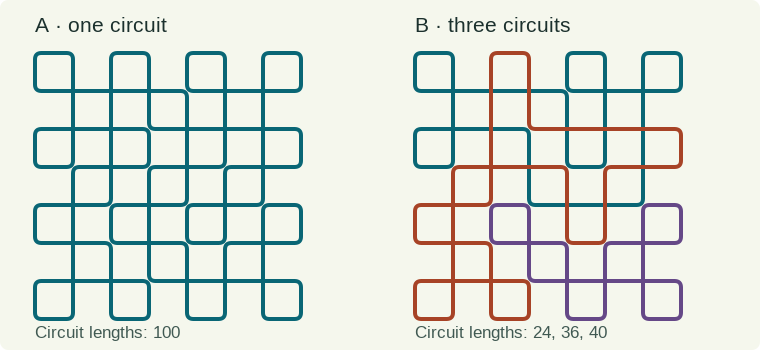
In a square gate model with Boolean states and a closed boundary, we count occupied subsets by their orbits under the symmetries of the square. The quadratic construction gives, for every even interior side length N≥4, pairs with equal quadratic signatures and one versus three circuits. An exhaustive computation at side length four and a cubic collision at side length six give three thresholds. Reconstruction up to symmetry requires degree four for every even N≥4. Determining the number of circuits requires degree three at side length four and degree four at every even side length from six onward. The same thresholds hold for deciding whether there is a single circuit. A ring whose states depend on one interior bit extends the cubic collision from side length six to every larger even side length, preserving both circuit partitions. The degree-four upper bound follows from a corollary of Alon, Caro, Krasikov, and Roditty on subset reconstruction.
1. Three questions about the same signature
The support graph of a pattern can be connected even if its local transitions partition its edges into several circuits. We ask how much information about the gate states is needed to reconstruct the configuration, count its circuits, or decide whether it consists of a single circuit. For each question and each side length N, we seek the least cumulative degree for which the complete signature determines the answer on all inputs at that size. We denote these thresholds by d_(orb)(N), d_c(N), and d_(mono)(N), respectively. The signature determines an observable precisely when the observable is constant on each fibre, the set of configurations sharing a count vector.
Theorem 1. Thresholds in the closed-boundary model
For even interior side lengths N≥4, the thresholds are as follows.
| Interior side | Reconstruction up to D_4 | Circuit count | Single-circuit test |
|---|---|---|---|
| 4 | 4 | 3 | 3 |
| Even ≥6 | 4 | 4 | 4 |
The gate model and the tracing procedure have precedents in Yanagisawa and Nagata [1, 2]. Sivakumar and Sivakumar [5] use the same gate carrier after rescaling and translating the index convention. The signatures are subset decks under a group action [3], and the degree-four upper bound is an application of [4]. The quadratic construction gives a degree-three lower bound for the single-circuit test at every admissible side length. Zero padding extends reconstruction collisions. An alternating-ring extension lifts the side-length-six collision while preserving the circuit counts.