
Closed paths on a grid
Can equal counts hide different paths?
Each site in these grids gives a rule for how lines continue through it. A circuit is a path that returns to its starting point. Compare the counts, then predict whether the two grids have the same number of circuits.
The counts agree
Choose one, two or three positions in the square. How often does that arrangement land entirely on marked sites when you turn or flip the square? The two grids give the same answer for every choice.
How is one entry counted?
Look at all distinct placements obtained by rotating or reflecting the square. Count each placement once if every chosen site is marked (a 1 in the grid data). The chosen sites can be far apart.
| Sites per group | Counts compared | Grids A and B |
|---|---|---|
| One | 6 | All equal |
| Two | 93 | All equal |
| Three | 920 | All equal |
All 1,019 entries match. Do you expect the circuits to match as well?
Trace the circuitsOne circuit and three
Follow the rounded bends to stay on a path where lines meet. In the interactive figure, select a numbered circuit in Grid B to see it by itself.
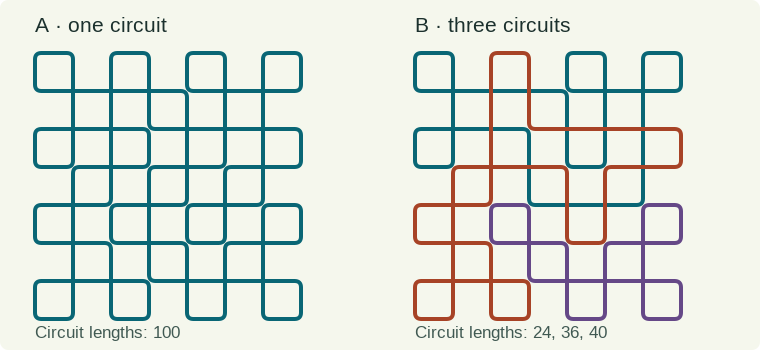
What the grids show
- Observation
- The two grids match through triples. Tracing gives one 100-edge circuit in A and three circuits of 24, 36 and 40 edges in B.
- Source
- N6 is a constructed pair of grids with six sites per side in the interior. Page 9 gives the exact pair, the matching counts and a four-site count that differs.
- Limit
- The figure demonstrates the result for this pair. A separate proof extends the construction to every even interior side length of at least six in the same model.