From sphere to strip
How much can you change a field before its zero line splits on a slice?
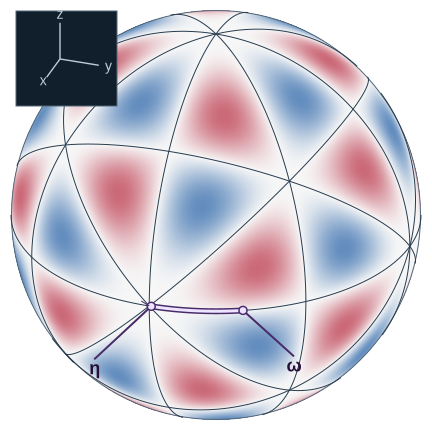
Blue is negative, white is zero and red is positive. The violet outline locates the equatorial arc at r = 0. The two sides of the narrow band are resolved in the chart.
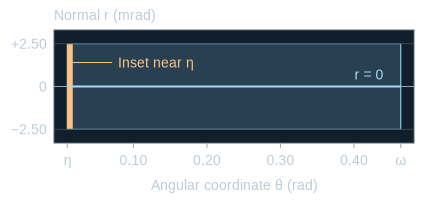
Move along the arc with θ or across it with r, the signed distance in radians. The chart stretches the two axes independently. Its top and bottom are r = ±δ. Its left and right edges are the complete terminal slices at θ = η and θ = ω.
- Left terminal η
- arctan(1/100)
- Right terminal ω
- arctan(1/2)
- Normal half-width δ
- ≈ 2.499745 mrad
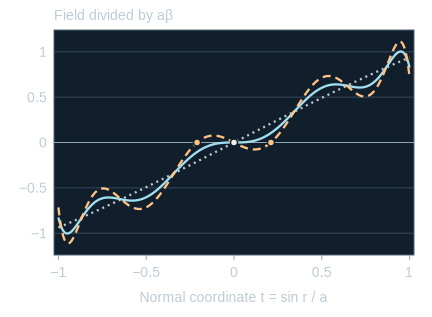
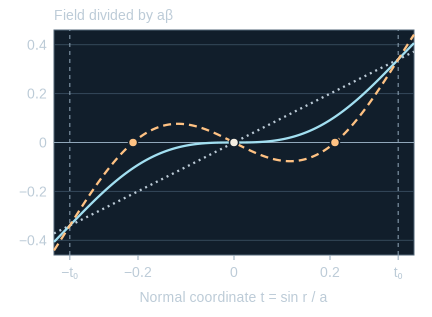
The charts use t = sin r / a, with a = sin δ. The dashed guides ±t₀ = ±sin(π/9) are where the perturbation vanishes. At factor 2 the field has opposite signs just to the right of zero and at t₀, so there is a crossing between them. Odd symmetry gives the crossing on the left.
Compare the centre slopes and the number of marked roots. The critical field flattens at the centre and still crosses there.
| Factor | Roots in t | Centre slope |
|---|---|---|
| 0 | 0 exactly | +β |
| 1 | 0 exactly | 0 |
| 2 | 0 exactly ≈ −0.210340, +0.210340 | −β |
The table gives the slope across the strip in r, before rescaling the field. Here β = ∂rF(η, 0) > 0. In plotted units the centre slopes are +1, 0 and −1. On this slice an exact polynomial root count gives three distinct zeros at factor 2. The two outer positions are rounded. The proof guarantees at least three zeros for every factor greater than 1 along this perturbation.
Why factor 1 still works. At this end of the strip the field crosses zero with a flat, cubic profile. For the critical perturbation the whole zero line still follows r = 0. The graph can survive even when its usual nonzero-slope test fails.
For this strip the exact radius is aβ/9, where β is the smaller of the two endpoint slopes. More generally, in either sufficient regime L or M the proof uses the smaller endpoint slope. It guarantees one interior zero graph with a continuous first derivative for every allowed change up to and including that radius. The size of a change is its largest absolute value on the whole closed strip. The allowed fields span all 100 real spherical modes through degree nine.
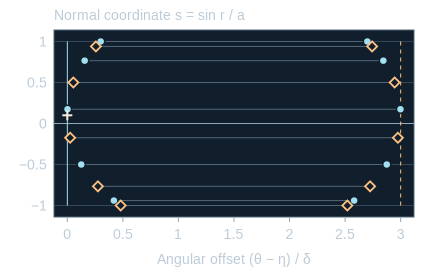
What the marks mean
Each row has two points with the same weight sign. The signs alternate between rows. The circles and diamonds label coefficients in the certificate, while the colours on the sphere encode the signed field.
In Figure 1 the example uses θ₀ = η, normal coordinate 1/10 and chord angle 3δ. The sign at level s = cos(jπ/9) is (−1)j for j = 0 through 9.
The proof establishes the representation on the full perturbation space. It allows other supported representations and does not assert that 20 is a minimal count.
Equation and scope
The target is the product of nine unit-normal mirror factors on the unit sphere. With F(θ, r) equal to that field in chart coordinates, the profiles plot (F + γEC)/(aβ), where EC = −(aβ/9)T₉(sin r / a) and T₉ is the degree-nine Chebyshev polynomial. The plotted curves and support coordinates evaluate the article’s formulas in floating point.
This is a dimensionless geometric field on a surface. Pressure, displacement, particle motion and deposition require their own models and evidence.